

Discrete Mathematics explores structures built upon discrete values‚ finding applications in computer science.
Numerous PDF resources‚ like Rosen’s and Epps’ texts‚ offer comprehensive coverage of these essential concepts.
What is Discrete Mathematics?
Discrete Mathematics‚ unlike calculus‚ deals with objects that can assume distinct‚ separated values. It’s the mathematical language of computer science‚ encompassing logic‚ set theory‚ graph theory‚ and combinatorics.
Accessible PDF versions of foundational texts‚ such as Rosen’s “Discrete Mathematics and Its Applications” and Epps’ “Discrete Mathematics with Applications”‚ are readily available online. These resources detail the core principles‚ offering a structured approach to understanding this vital field.
It forms the bedrock for algorithmic thinking and problem-solving.
Why Study Discrete Mathematics?
Discrete Mathematics is fundamental for anyone pursuing computer science‚ engineering‚ or related fields. Its principles underpin programming‚ algorithm design‚ and data analysis. Studying it enhances logical reasoning and problem-solving skills.
Numerous PDF resources‚ including Kolman’s “Discrete Mathematical Structures”‚ provide practical applications. Understanding these concepts is crucial for cryptography‚ network analysis‚ and software development.
Furthermore‚ it provides a solid mathematical foundation for advanced studies and real-world technological challenges.
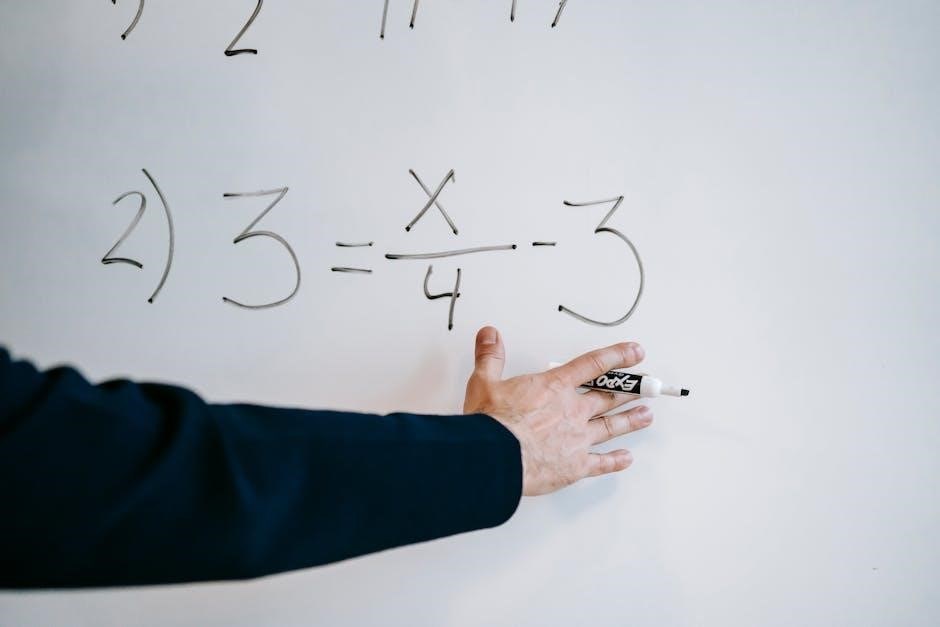
Fundamental Concepts
Discrete Mathematics builds upon logic‚ set theory‚ and proof techniques. Accessible PDF resources‚ like those by Epp‚ detail these core concepts for diverse applications.
Logic and Proofs
Logic and Proofs form the bedrock of mathematical reasoning within Discrete Mathematics. This area encompasses propositional and predicate logic‚ establishing the rules for valid arguments.
Crucially‚ mastering various proof methods – direct‚ indirect‚ and contradiction – is essential. Several PDF textbooks‚ including those by Rosen and Kolman‚ thoroughly explain these techniques.
These foundational concepts are vital for verifying the correctness of algorithms and systems‚ underpinning many computer science applications detailed in available resources.
Propositional Logic
Propositional Logic deals with statements that are either true or false‚ connected by logical operators like AND‚ OR‚ and NOT. It’s a fundamental component of Discrete Mathematics‚ providing a formal system for reasoning about these statements.
Resources like Rosen’s “Discrete Mathematics and Its Applications” PDF offer detailed explanations and examples. Understanding truth tables and logical equivalences is key.
This logic is crucial for designing digital circuits and verifying software correctness‚ as highlighted in various application-focused texts.
Predicate Logic
Predicate Logic extends Propositional Logic by introducing variables‚ quantifiers (like “for all” and “there exists”)‚ and predicates to express properties and relationships. This allows for more nuanced and powerful statements about objects and their attributes.
Many PDF resources‚ including Kolman’s “Discrete Mathematical Structures”‚ delve into predicate logic’s intricacies.
It’s essential for formalizing mathematical arguments and database queries‚ offering a more expressive framework than propositional logic alone‚ as demonstrated in application examples.
Methods of Proof (Direct‚ Indirect‚ Contradiction)
Discrete Mathematics relies heavily on rigorous proofs. Direct Proofs start with assumptions and logically conclude the desired statement. Indirect Proofs (contrapositive) prove the converse. Proof by Contradiction assumes the negation and derives a contradiction‚ validating the original statement.
Resources like Rosen’s PDF textbook extensively cover these techniques‚ providing examples and exercises.
Mastering these methods is crucial for verifying algorithms and establishing the correctness of mathematical arguments within computer science applications.
Set Theory
Set Theory forms a foundational element of Discrete Mathematics‚ dealing with collections of objects. Key concepts include defining sets‚ subsets‚ and performing operations like union‚ intersection‚ and complement. Understanding these operations is vital for modeling and solving problems in various applications.
Numerous PDF resources‚ including those by Rosen and Kolman‚ detail these concepts.
Exploring Power Sets and Cartesian Products expands the possibilities for representing relationships and structures‚ crucial for computer science and beyond.
Basic Set Operations
Basic Set Operations – union‚ intersection‚ difference‚ and complement – are fundamental tools within Set Theory and Discrete Mathematics. The union combines elements from multiple sets‚ while intersection identifies common elements. The difference isolates elements unique to a set‚ and the complement finds elements not within it.
These operations‚ thoroughly explained in PDF textbooks like Rosen’s‚ are essential for problem-solving.
Mastering these concepts allows for precise representation and manipulation of data‚ crucial for various applications.
Power Sets and Cartesian Products
Power Sets represent all possible subsets of a given set‚ including the empty set and the set itself. Their cardinality is 2n‚ where ‘n’ is the original set’s size. Cartesian Products‚ conversely‚ create ordered pairs from elements of two sets‚ forming new sets.
These concepts‚ detailed in Discrete Mathematics PDF resources‚ are vital for defining relations and functions.
Understanding these operations is crucial for modeling complex relationships and structures within various applications.

Combinatorics
Combinatorics focuses on counting and arranging objects‚ utilizing principles like permutations and combinations. Discrete Mathematics PDF texts‚ such as those by Rosen and Epps‚ detail these methods.
Counting Principles
Counting principles form a core component of combinatorics‚ enabling the systematic enumeration of possibilities. Foundational concepts include permutations – ordered arrangements – and combinations‚ focusing on selections without regard to order.
Resources like Rosen’s “Discrete Mathematics and Its Applications” and Epps’ “Discrete Mathematics with Applications”‚ often available as PDF downloads‚ thoroughly explain these principles. The Binomial Theorem‚ a powerful tool for expanding binomials‚ is also extensively covered within these texts‚ providing a framework for calculating combinations efficiently. These PDF materials offer numerous examples to solidify understanding.
Permutations and Combinations
Permutations and combinations are fundamental counting techniques within discrete mathematics. Permutations calculate arrangements where order matters‚ while combinations focus on selections irrespective of order. Understanding the distinction is crucial for solving various problems.
Many PDF resources‚ including Susanna Epps’ “Discrete Mathematics with Applications” and Kenneth Rosen’s textbook‚ provide detailed explanations and examples. These PDF materials demonstrate how to apply formulas for calculating permutations (nPr) and combinations (nCr)‚ essential for probability and algorithm analysis. Practical applications are often highlighted within these texts.
Binomial Theorem
The Binomial Theorem provides a formula for expanding expressions of the form (x + y)n‚ where ‘n’ is a non-negative integer. It relates binomial coefficients – found within Pascal’s Triangle – to the coefficients in the expansion.
Numerous PDF resources‚ such as Kenneth Rosen’s “Discrete Mathematics and Its Applications”‚ thoroughly explain this theorem and its applications. These PDF materials demonstrate how to calculate binomial coefficients and utilize the theorem for probability calculations and combinatorial proofs. Understanding the theorem is vital for various mathematical disciplines.
Pigeonhole Principle
The Pigeonhole Principle is a deceptively simple yet powerful concept in discrete mathematics; It states that if you have more pigeons than pigeonholes‚ at least one pigeonhole must contain more than one pigeon. This principle has broad applications in proving existence results.
Many PDF resources‚ including Susanna Epps’ “Discrete Mathematics with Applications”‚ illustrate this principle with engaging examples. These PDF documents demonstrate how to apply the principle to solve problems in combinatorics and computer science‚ showcasing its utility in various scenarios.

Graph Theory
Graph Theory examines relationships modeled with vertices and edges; crucial for network analysis. PDF textbooks‚ like those by Rosen and Kolman‚ detail graph traversal algorithms.
Basic Graph Definitions
Graph Theory fundamentally relies on defining graphs – structures composed of vertices (nodes) and edges connecting them. These can be undirected‚ where edges have no direction‚ or directed‚ indicating a one-way relationship.
Understanding these basic definitions is paramount‚ and resources like those found in PDF format – specifically Rosen’s “Discrete Mathematics and Its Applications” and Kolman’s “Discrete Mathematical Structures” – provide detailed explanations. These texts cover essential concepts like adjacency‚ paths‚ and cycles‚ forming the foundation for more advanced graph algorithms and applications.
Types of Graphs (Undirected‚ Directed)
Undirected graphs feature edges with no inherent direction‚ representing a two-way relationship between vertices. Conversely‚ directed graphs (digraphs) employ edges with a specified direction‚ modeling one-way connections.
Exploring these distinctions is crucial‚ and comprehensive PDF resources like Epp’s “Discrete Mathematics with Applications” and Rosen’s textbook thoroughly explain their properties. Understanding these graph types is fundamental for modeling real-world scenarios and applying appropriate algorithms‚ as detailed within these accessible learning materials.
Graph Traversal Algorithms
Graph traversal algorithms systematically visit each vertex within a graph. Depth-First Search (DFS) explores as far as possible along each branch before backtracking‚ while Breadth-First Search (BFS) explores all neighbors at the present depth prior to moving on.
These algorithms are vital for numerous applications. Detailed explanations and examples are readily available in PDF resources like Kolman’s “Discrete Mathematical Structures” and Rosen’s text‚ aiding comprehension of their implementation and utility in solving complex problems.
Depth-First Search (DFS)
Depth-First Search (DFS) is a graph traversal algorithm that explores as deeply as possible along each branch before backtracking. It begins at the root node and explores each branch completely before moving to the next sibling branch.
Understanding DFS is crucial‚ and resources like Rosen’s “Discrete Mathematics and Its Applications” PDF provide detailed explanations and examples. These materials clarify its recursive nature and applications in pathfinding‚ topological sorting‚ and cycle detection within graph structures.
Breadth-First Search (BFS)
Breadth-First Search (BFS) systematically explores a graph level by level‚ starting at a designated root node. It prioritizes visiting all neighbors at the current depth before moving to the next level‚ ensuring the shortest path is discovered first.
Numerous PDF resources‚ including Kolman’s “Discrete Mathematical Structures‚” illustrate BFS with practical examples; These materials demonstrate its utility in finding shortest paths‚ network broadcasting‚ and analyzing graph connectivity‚ solidifying its importance in discrete mathematics applications.

Algebraic Structures
Algebraic Structures‚ like groups‚ rings‚ and fields‚ are fundamental in discrete mathematics. PDF textbooks‚ such as those by Rosen and Kolman‚ detail these concepts and their applications.
Groups
Groups represent a core algebraic structure within discrete mathematics‚ defined by a set and an operation satisfying specific axioms: closure‚ associativity‚ identity‚ and inverse. These structures are extensively utilized in cryptography and coding theory‚ providing a mathematical foundation for secure communication and data representation.
Resources like Kenneth Rosen’s “Discrete Mathematics and Its Applications” (PDF available) and Bernard Kolman’s “Discrete Mathematical Structures” offer detailed explanations and examples of group theory. Understanding groups is crucial for analyzing symmetries and transformations‚ impacting various computational algorithms and problem-solving techniques.
Rings
Rings‚ building upon group theory‚ introduce two operations – addition and multiplication – with specific properties like associativity and distributivity. They are fundamental in abstract algebra and have significant applications in areas like error-correcting codes and polynomial algebra. Exploring ring structures provides a powerful framework for mathematical modeling.
Several PDF resources‚ including Susanna Epps’ “Discrete Mathematics with Applications” and Rosen’s textbook‚ delve into ring theory with illustrative examples. These texts demonstrate how rings generalize familiar number systems‚ offering insights into modular arithmetic and cryptographic algorithms.
Fields
Fields represent a more specialized algebraic structure than rings‚ requiring multiplicative inverses for all non-zero elements. This property enables division‚ crucial for solving equations and performing complex calculations. Fields are foundational to many areas of mathematics and computer science‚ including cryptography and coding theory.
Resources like Kolman’s “Discrete Mathematical Structures” (PDF available) and Rosen’s comprehensive text provide detailed explanations and examples of field properties. These materials illustrate how fields‚ such as rational and real numbers‚ underpin numerous applications in discrete mathematics.

Lattices and Boolean Algebra
Lattices and Boolean Algebra provide structures for logical operations‚ vital in digital circuit design. PDF resources detail these concepts and their practical applications.
Lattice Properties
Lattices‚ fundamental in discrete mathematics‚ exhibit specific properties defining their structure. These include reflexive‚ symmetric‚ and transitive relations‚ ensuring well-defined ordering. PDF textbooks‚ such as those by Rosen and Kolman‚ thoroughly explain concepts like join and meet operations‚ crucial for lattice manipulation. Understanding these properties is essential for analyzing Boolean algebras and their applications in logic circuits and set theory. Lattice properties facilitate simplification of complex logical expressions and provide a foundation for formal verification techniques‚ as detailed in available academic resources.
Boolean Functions and Expressions
Boolean Functions‚ central to digital logic and computer science‚ operate on binary variables. These functions are represented by Boolean Expressions utilizing operators like AND‚ OR‚ and NOT. Numerous PDF resources‚ including those by Rosen and Kolman‚ detail simplification techniques like Boolean algebra laws. Understanding these expressions is vital for designing and analyzing digital circuits. They form the basis for representing logical conditions in programming and database queries‚ as explored in discrete mathematics applications texts.

Recursion and Recurrence Relations
Recursion defines objects in terms of themselves‚ crucial in computer science. PDF resources‚ like those by Epp‚ illustrate recursive definitions and solving recurrence relations effectively.
Recursive Definitions
Recursive definitions are foundational in discrete mathematics‚ enabling the expression of complex objects through self-reference. These definitions consist of base cases – initial conditions – and recursive steps that build upon prior results.
Numerous PDF resources‚ including texts by Rosen‚ Epps‚ and Kolman‚ provide detailed examples of recursively defined functions and structures. These examples often include factorial calculations‚ Fibonacci sequences‚ and tree structures. Understanding recursion is vital for algorithm design and analysis‚ particularly in computer science applications.
The ability to translate problems into recursive formulations is a key skill‚ and these texts offer practical exercises to hone this ability‚ solidifying comprehension of this powerful technique.
Solving Recurrence Relations
Solving recurrence relations is crucial for analyzing algorithms and understanding the growth of recursively defined sequences. Techniques include iteration‚ substitution‚ the characteristic equation method‚ and generating functions. These methods allow us to find explicit formulas for terms in the sequence.
Comprehensive PDF resources‚ such as those by Rosen‚ Epps‚ and Kolman‚ dedicate significant sections to these solution techniques‚ providing numerous examples and practice problems. Mastering these methods is essential for evaluating the efficiency of recursive algorithms and predicting their behavior.
These texts demonstrate how to apply these techniques to common recurrence relations encountered in computer science and mathematics.

Discrete Probability
Discrete probability examines events with finite outcomes‚ vital for computer science applications. PDF textbooks‚ like those by Rosen and Epps‚ detail core concepts and theorems.
Basic Probability Concepts
Fundamental to discrete probability is understanding sample spaces and events. A sample space defines all possible outcomes‚ while an event is a subset of this space. Probability‚ expressed as a value between zero and one‚ quantifies the likelihood of an event’s occurrence.
Resources like PDF versions of Rosen’s “Discrete Mathematics and Its Applications” and Epps’ text thoroughly explain these concepts with numerous examples. These texts cover axioms of probability‚ including the non-negativity‚ normalization‚ and additivity principles‚ forming the bedrock for further analysis.
Conditional Probability and Bayes’ Theorem
Conditional probability assesses the likelihood of an event given that another event has already occurred‚ denoted as P(A|B). Bayes’ Theorem then builds upon this‚ providing a method to update probabilities based on new evidence. These concepts are crucial for statistical inference and decision-making.
Detailed explanations and practical applications of both are readily available in PDF versions of standard discrete mathematics texts‚ such as those by Rosen and Epps. These resources offer worked examples illustrating how to apply Bayes’ Theorem in various scenarios.

Applications of Discrete Mathematics
Discrete Mathematics underpins computer science‚ cryptography‚ and network analysis; accessible through numerous PDF resources like textbooks by Rosen‚ Epps‚ and Kolman.
Computer Science Applications
Discrete Mathematics forms the theoretical foundation for numerous computer science fields. Algorithms‚ data structures‚ and database management heavily rely on concepts like logic‚ set theory‚ and graph theory. PDF resources‚ including those by Rosen and Epps‚ demonstrate these connections through practical examples.
The study of recursion‚ crucial for programming‚ is detailed in available documents. Furthermore‚ understanding Boolean algebra is essential for digital logic design and computer architecture. These PDF materials provide a strong base for aspiring computer scientists‚ offering experiential learning and clarifying abstract concepts.
Cryptography Applications
Discrete Mathematics is fundamentally vital to modern cryptography. Number theory‚ modular arithmetic‚ and combinatorics underpin encryption algorithms like RSA and AES. PDF textbooks‚ such as those by Rosen‚ Kolman‚ and Epps‚ illustrate how these mathematical principles secure digital communication.
Concepts like prime numbers‚ finite fields‚ and group theory are essential for designing robust cryptographic systems. The analysis of these systems also relies heavily on discrete mathematical tools. Accessing relevant PDF documents provides a solid understanding of these applications‚ crucial for cybersecurity professionals.
Network Analysis Applications
Discrete Mathematics provides the foundational tools for analyzing networks‚ from computer networks to social networks. Graph Theory‚ a core component‚ models network structures and allows for efficient analysis of connectivity and data flow. Resources like PDF versions of Rosen’s and Epps’ texts demonstrate these applications.
Algorithms like Dijkstra’s and breadth-first search‚ rooted in discrete math‚ optimize network routing. Understanding network capacity‚ reliability‚ and security relies on combinatorial principles. Studying these concepts through accessible PDF materials is essential for network engineers and researchers.

Resources and Textbooks
Rosen’s‚ Epps’‚ and Kolman’s texts are vital resources. Accessible PDF versions of these books provide comprehensive coverage of Discrete Mathematics concepts.
Rosen’s “Discrete Mathematics and Its Applications”
Kenneth Rosen’s widely-used textbook‚ “Discrete Mathematics and Its Applications‚” is a cornerstone for students. Available in various editions‚ including a 7th edition PDF‚ it provides a thorough exploration of fundamental concepts.
The book covers logic‚ set theory‚ functions‚ relations‚ combinatorics‚ graph theory‚ and more. Its 984 pages (in the 4th edition) offer numerous examples and exercises‚ making it ideal for self-study or classroom use.
Students benefit from its clear explanations and practical applications‚ solidifying their understanding of this crucial mathematical field. Finding a PDF copy facilitates convenient access to this valuable resource.
Epps’ “Discrete Mathematics with Applications”
Susanna Epps’ “Discrete Mathematics with Applications” is a respected text‚ offering a student-friendly approach to the subject. A 5th edition PDF version is readily available‚ providing comprehensive coverage of essential topics.
The book delves into logic‚ set theory‚ relations‚ functions‚ combinatorics‚ graph theory‚ and algebraic structures. It emphasizes practical applications‚ illustrating how discrete mathematics solves real-world problems.
Its clear writing style and numerous examples make complex concepts accessible. Students appreciate its focus on experiential learning‚ enhancing comprehension and problem-solving skills. Accessing the PDF streamlines study.
Kolman’s “Discrete Mathematical Structures”
Bernard Kolman’s “Discrete Mathematical Structures” is a foundational text for students entering the field. A 4th edition exists in DJVU format‚ alongside potential PDF conversions‚ offering a robust exploration of core principles.
The book systematically covers logic‚ set theory‚ relations‚ functions‚ number theory‚ combinatorics‚ graph theory‚ and Boolean algebra. It’s known for its rigorous approach and detailed explanations.
Kolman’s work emphasizes mathematical maturity‚ preparing students for advanced coursework. While potentially less application-focused than some texts‚ it builds a strong theoretical base‚ valuable for deeper understanding.